

1. Raw material preparation
(1) Fiber selection
Cotton fiber (most common): soft, highly absorbent, suitable for medical gauze.
Hemp fiber (such as linen): has good breathability, but is relatively rough and is often used in industrial gauze.
Synthetic fibers (such as polyester): used for special purposes (such as waterproof gauze).
(2) Fiber processing
Cotton cleaning: Removing impurities (such as seeds and leaves) from cotton.
Combing: Combing fibers to make them parallel and improve yarn uniformity.
Combing (optional): further removes short fibers to make the yarn smoother (used for high-end medical gauze).

2. Spinning (turning fibers into yarn)
(1) Roving yarn
The fibers are stretched and twisted to form thicker yarn strips (rovings).
(2) Fine yarn
Roving is further refined and twisted through ring spinning or air spinning processes to form fine yarn (usually 10-40 count yarn, with higher count yarn becoming finer).
Medical gauze usually uses 20-40 threads to ensure softness and strength.
3. Weaving (weaving yarn into a mesh structure)
(1) Whole Scripture
The yarn is arranged on the warp axis with a fixed length and density to prepare for weaving.
(2) Weaving
Plain weave (most common): warp and weft yarns are interwoven one by one to form a uniform mesh structure.
Features: Breathable, soft, but prone to detachment (requiring edge locking treatment).
Twill/satin weave (rarely used): used for special purposes (such as bandages).
(3) Fabric inspection
Check for any issues such as broken yarn or holes.
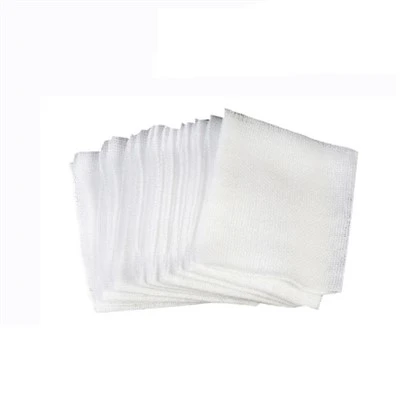
4. Bleach and dye (optional)
(1) Bleach (essential for medical gauze)
Chlorine or oxygen bleach: removes the yellow color of natural cotton fibers and turns the gauze white.
Defatting treatment: Improve water absorption (medical gauze must comply with YY/T 0330 standard).
(2) Dyeing (industrial gauze)
Use environmentally friendly dyes, such as reactive dyes, to ensure color fastness.