

What is a PBT bandage ?
Material Genetics Define Performance
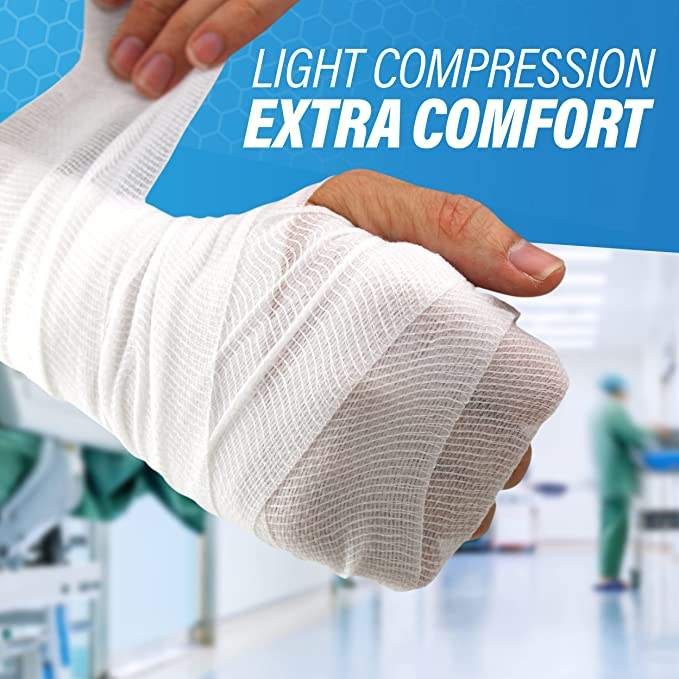
A PBT bandage is an elastic medical dressing primarily made from Polybutylene Terephthalate multifilament yarns. As a semi‑crystalline thermoplastic polyester, PBT offers several clinically relevant physical properties:
Superior elastic recovery – After repeated stretching, PBT returns rapidly to its original length with minimal permanent deformation, which is critical for long‑term compression therapy in chronic wounds.
Excellent hydrophilicity – Compared with conventional PET or cotton, PBT has better moisture transport capability, effectively wicking exudate away from the wound bed to prevent maceration.
Good chemical resistance – It withstands weak acids, bleach, and common disinfectants, allowing cleaning and limited reuse where applicable.
Low allergenicity – The smooth fibre surface reduces friction and irritation against sensitive skin, making it suitable for paediatric and geriatric patients.
Compared with traditional cotton bandages, PBT variants exhibit lower areal density and thinner profiles, translating into lighter weight and noticeably improved wearing comfort. Versus pure spandex bandages, PBT overcomes spandex's known shortcomings-poor fatigue resistance, rapid elastic decay, and susceptibility to chlorine damage-delivering more consistent performance over extended use.
The Core Process: Warp Knitting – Warp Yarns for Strength, Weft Yarns for Elasticity
The outstanding performance of PBT bandages is not derived from the fibre alone; it is equally attributable to the warp‑knitting technique. Unlike woven or weft‑knitted fabrics, warp knitting feeds all yarns simultaneously along the fabric length (warp direction) through multiple guide needles, forming intermeshed loop chains.
Warp Yarns (Longitudinal) – Provide Structural Strength
Warp yarns are typically high‑tenacity, low‑shrinkage PET filaments, forming closed or open loop chains along the machine direction. These interlocked loops determine the bandage's dimensional stability, tensile strength, and tear resistance. In standard medical‑grade warp‑knitted bandages, the warp density is usually controlled at 18–22 loops per centimetre-sufficient to ensure structural integrity without making the fabric overly rigid.
Weft Yarns (Transverse) – Deliver the Core Elasticity
Weft yarns are PBT elastic filaments inserted as inlay threads between the warp loops under controlled tension. After knitting, a heat‑setting process (typically at 180–200°C) induces thermal shrinkage in the PBT weft, storing elastic potential energy in the transverse direction. When the bandage is stretched laterally, the crimped PBT yarns are straightened; upon release, the entropic elasticity of the polymer chains drives full recovery.
How to Choose?
PBT bandages are not a one‑size‑fits‑all product. Three main configurations have evolved to address distinct clinical demands, differing primarily in areal density, thickness, elastic modulus, and surface texture.
Parameter
Areal density
Thickness
Elongation (weft)
Compression level
Breathability
Cushioning effect
Thin PBT Bandage
~80–120 g/m²
0.4–0.6 mm
70%–100%
Low (mild fixation)
★★★★★
None
Thick PBT Bandage
~180–250 g/m²
0.9–1.3 mm
60%–85%
Medium–high (haemostasis / venous therapy)
★★★☆☆
Significant, protects bony prominences
Spandex‑Blend PBT Bandage
~130–180 g/m²
0.6–0.8 mm
120%–160%
High (scar management / sports)
★★★★☆
Moderate

Thin PBT Conforming Bandage – Lightweight, Breathable, Ideal for Fine Dressing
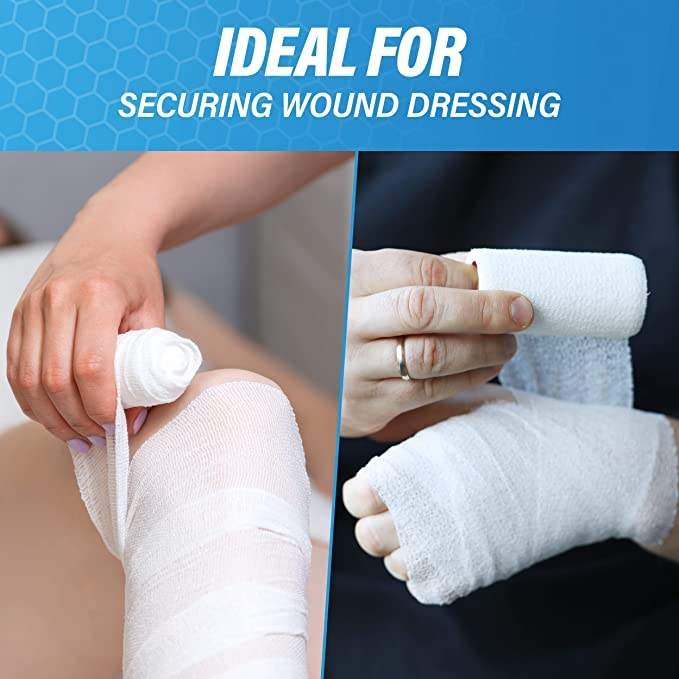
With an areal density no higher than 120 g/m², the thin variant excels in conformability and breathability. It is particularly suitable for anatomically complex areas such as fingers, toes, wrists, and the cubital fossa. In plastic surgery and burn units, it is frequently used as a secondary dressing retention layer-securing gauze without applying excessive pressure to delicate healing tissue.
Best for: Post‑operative mild fixation, minor abrasion dressing, and wound care during hot and humid conditions.
Thick PBT Bandage – Strong Compression with Even Load Distribution
By increasing PBT weft yarn thickness or loop density, the thick variant offers a more substantial cushioning effect and superior pressure dispersion. In chronic venous insufficiency (CVI)‑related leg ulcer management, Thick Conforming Stretchable Bandage are often employed as the intermediate or outer layer in multi‑layer compression systems, delivering sustained, evenly distributed graduated pressure from the distal leg upward.
Best for: Venous ulcer compression therapy, complete decongestive therapy (CDT) for lymphoedema, and post‑sprain immobilisation with moderate to high compression.
Spandex‑Blend PBT Bandage – High‑Elongation, Dynamic Fixation Expert
This variant incorporates spandex (elastane) fibres alongside PBT as the elastic weft component. Spandex offers an ultimate elongation of 400%–600%, so the blended bandage achieves a significantly higher working stretch ratio than pure PBT. At the same time, the addition of PBT compensates for spandex's two main weaknesses-poor fatigue resistance (elastic decay after repeated cycles) and limited heat tolerance (vulnerable to high‑temperature dyeing). The combination ensures high compression intensity while maintaining stable elastic output after repeated wear and washing.
Best for: Post‑burn scar pressure therapy (requiring 23 hours/day compression), athletic joint protection, and postoperative dynamic joint stabilisation (e.g., after total knee arthroplasty).