

Are there tweezers for scientific research?

In the vast realm of scientific research, precision and accuracy are of utmost importance. Every tool used in a laboratory setting plays a crucial role in ensuring the integrity of experiments and the reliability of results. One such tool that often goes unnoticed but is indispensable in many scientific disciplines is the humble tweezers. But the question arises: are there tweezers specifically designed for scientific research? The answer is a resounding yes.
As a tweezers supplier, I have witnessed firsthand the diverse needs of the scientific community. Different types of research require tweezers with specific characteristics, such as material, size, and tip shape. Let's delve into the world of scientific tweezers and explore the various options available.
Material Matters
The material of a tweezer can significantly impact its performance in a scientific setting. One common material used for scientific tweezers is stainless steel. Stainless steel tweezers are known for their durability, resistance to corrosion, and ease of sterilization. They can withstand repeated use and exposure to various chemicals, making them ideal for applications in biology, chemistry, and physics laboratories.
Another material that is gaining popularity in scientific research is titanium. Titanium tweezers are lightweight, strong, and non - magnetic. These properties make them suitable for use in sensitive experiments where magnetic interference could affect the results, such as in electron microscopy or certain types of spectroscopy.
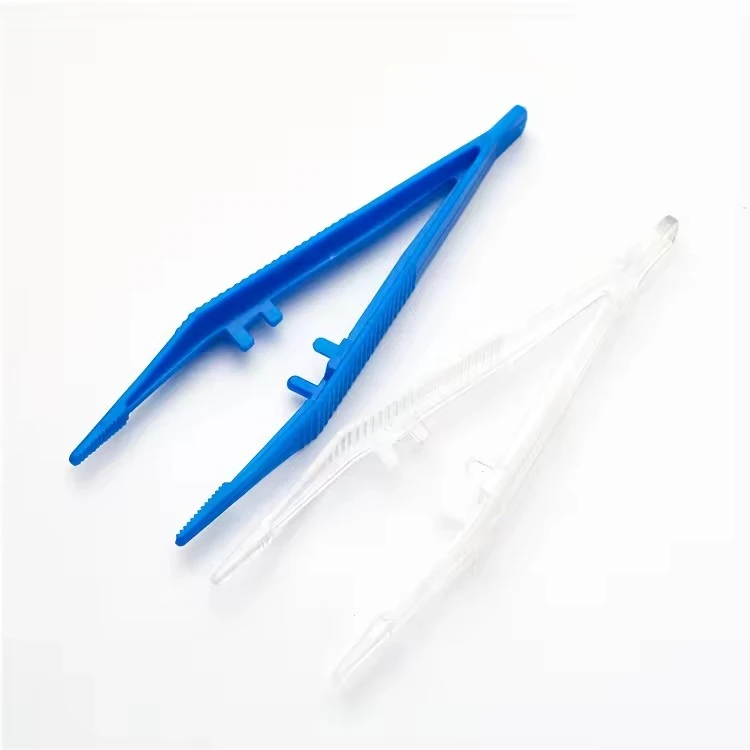
For applications where non - reactive materials are required, plastic tweezers come into play. Blue Plastic Tweezers are often used in biological research, especially when handling samples that may be contaminated by metal ions. They are also flexible, which can be an advantage when delicate manipulation is needed.
Size and Shape
The size and shape of tweezers are tailored to the specific tasks in scientific research. Long tweezers, such as Long Metal Tweezers, are useful for reaching into deep containers or for handling samples in hard - to - reach places. They provide better access and control in situations where regular - sized tweezers would be ineffective.
On the other hand, fine - tipped tweezers are essential for tasks that demand high precision. In microelectronics research, for example, fine - tipped tweezers are used to handle tiny components like resistors and capacitors. The sharp tips allow for accurate placement and manipulation of these small parts.
There are also specialty tweezers with unique shapes. Some tweezers have curved tips, which can be beneficial for tasks like removing debris from curved surfaces or for handling samples in irregularly shaped containers.
Applications in Different Scientific Fields
Biology
In biology, tweezers are used for a wide range of tasks. In cell culture, tweezers are used to transfer small tissue samples or to handle coverslips. They are also used in dissection procedures, where they help in separating and manipulating delicate tissues. For example, when studying the nervous system of small organisms, fine - tipped tweezers are used to isolate individual nerve fibers.
Chemistry
Chemistry laboratories rely on tweezers for handling small chemical samples. They are used to pick up crystals, transfer small amounts of powders, or to manipulate small glassware components. In analytical chemistry, tweezers are used to place samples on weighing boats or to handle electrodes during electrochemical experiments.
Physics
In physics research, tweezers are used in areas such as nanotechnology. Optical tweezers, for instance, use laser light to trap and manipulate tiny particles, such as atoms or nanoparticles. These high - tech tweezers have revolutionized the study of single - molecule biophysics and nanoscale materials.
Quality and Sterilization
When it comes to scientific research, the quality of tweezers is non - negotiable. High - quality tweezers have precise tips that can grip objects firmly without damaging them. They also have a smooth opening and closing action, which is essential for accurate manipulation.
Sterilization is another critical aspect. In biological and medical research, tweezers need to be sterilized to prevent contamination of samples. Stainless steel tweezers can be easily sterilized using methods such as autoclaving or chemical disinfection. Plastic tweezers may require different sterilization methods, such as gamma irradiation, depending on their material composition.
Customization
As a tweezers supplier, I understand that sometimes the standard tweezers may not meet the unique requirements of a particular research project. That's why we offer customization services. We can manufacture tweezers with specific materials, sizes, and tip shapes according to the customer's specifications. This allows researchers to have tweezers that are perfectly tailored to their needs.
The Importance of Choosing the Right Tweezers
Using the wrong type of tweezers in a scientific experiment can lead to inaccurate results or even damage to the samples. For example, using metal tweezers in a non - magnetic environment can introduce magnetic interference, while using dull - tipped tweezers for a high - precision task can result in poor manipulation and potentially ruin the experiment.
Therefore, it is crucial for researchers to carefully consider their needs and choose the appropriate tweezers. This involves understanding the nature of the research, the type of samples being handled, and the specific tasks that need to be performed.
Conclusion
In conclusion, there are indeed tweezers specifically designed for scientific research. The wide variety of materials, sizes, and shapes available ensures that there is a tweezer suitable for every scientific application. As a tweezers supplier, we are committed to providing high - quality tweezers that meet the demanding needs of the scientific community.
If you are involved in scientific research and are in need of tweezers, we invite you to contact us for a detailed discussion about your requirements. Our team of experts can help you select the right tweezers for your project or even customize tweezers to fit your unique needs. Let's work together to ensure the success of your scientific endeavors.
References
- "Laboratory Techniques in Biochemistry and Molecular Biology" by T. S. Work and E. Work.
- "Nanoscale Science and Technology: An Introduction with Experiments" by Charles P. Poole Jr. and Frank J. Owens.
- "The Art of Scientific Investigation" by W. I. B. Beveridge.